Introduction
Overview
The Kerry Group are a provider of ingredients and technologies to enhance the taste, nutrition and functionality of food and beverage products. Kerry PrediX is a web-based tool to enable account managers to cross-sell and up-sell Kerry ingredients and technologies to customers. The project duration was from June 2021 through to November 2022, with 12 weeks to build a minimal viable product (MVP) which was initially deployed as a Power BI application. After confirming the viability of the MVP, the application was ported to a web-based solution and iteratively improved.
My Role
Working with the McKinsey group, the Kerry data science team, Product Owner and Senior Designer, I was involved in initial user research, wire-framing, prototyping and testing. I was also involved with iterative improvements to the tool, additional prototyping and user testing.
Project background
The Kerry PrediX project was part of a series of initiatives titled the ‘One Kerry’ program, designed to place the customer at the heart of Kerry, and make it easy and more valuable to do business throughout the customer journey. The vision was to use data and analytics to improve sales effectiveness through cross-sell and up-sell insights.
Objectives
The project objectives were to:
- Provide customers with tailored advice on product recommendations through the use of market trends, product and customer data sets to drive growth
- Empower account managers to improve customer conversations and become more value-added partners
- Demonstrate potential for Kerry to accelerate commercial performance through existing products and data assets
- Use data and analytics to drive 3-5% sales growth
- Embed the Agile way of working within the organisation
Research goals and methods - 'Understand' sprint
Initial research was scheduled within a two week ‘understand’ sprint.
Key research goals included:
- Understand current sales processes
- Understand the current technical architecture (back-end data, analytics stack, frontend tools)
- User pain points and needs in the cross-sell / up-sell journey
- Understand existing collaterals and their usage
- Finalise use cases based on prioritisation criteria and agree on leading KPIs
Key research methods included:
- Engaging with Marketing to understand sales collaterals and how they are being leveraged (5+ interviews)
- Interviews with regional account managers to understand needs, pain points, tools used (10+ interviews)
- Interviews with Kerry customers to understand their decision-making behaviours, values and needs (5 customers)
Insights from engagements and interviews were collated using the Dovetail platform, allowing us to uncover user requirements and pain points.
Key insights from research – ‘Concept’ sprint
Following analysis of the findings from the ‘understand’ sprint, the ‘concept’ sprint was initiated, which ran for a further two weeks.
Problem identification
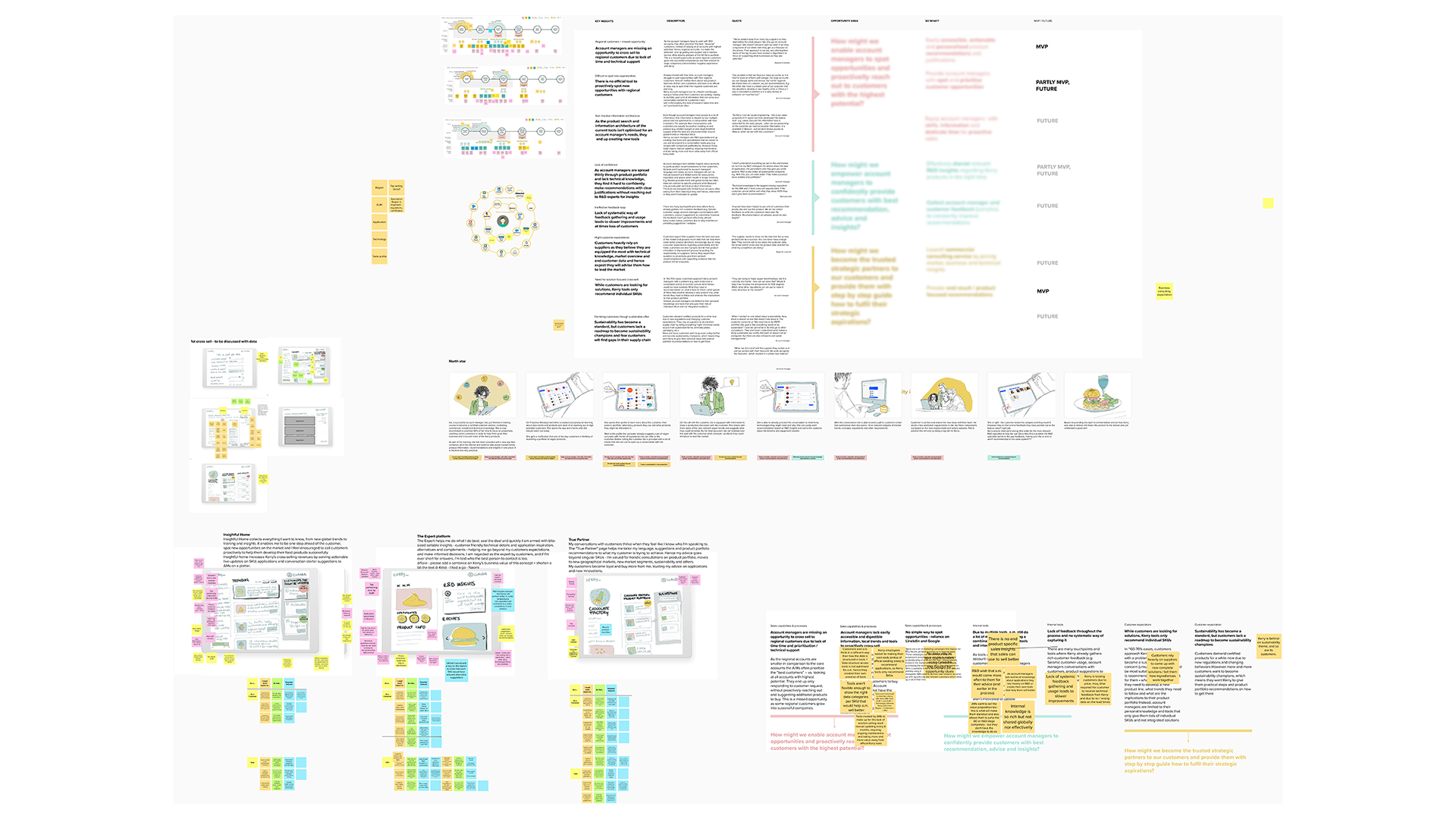
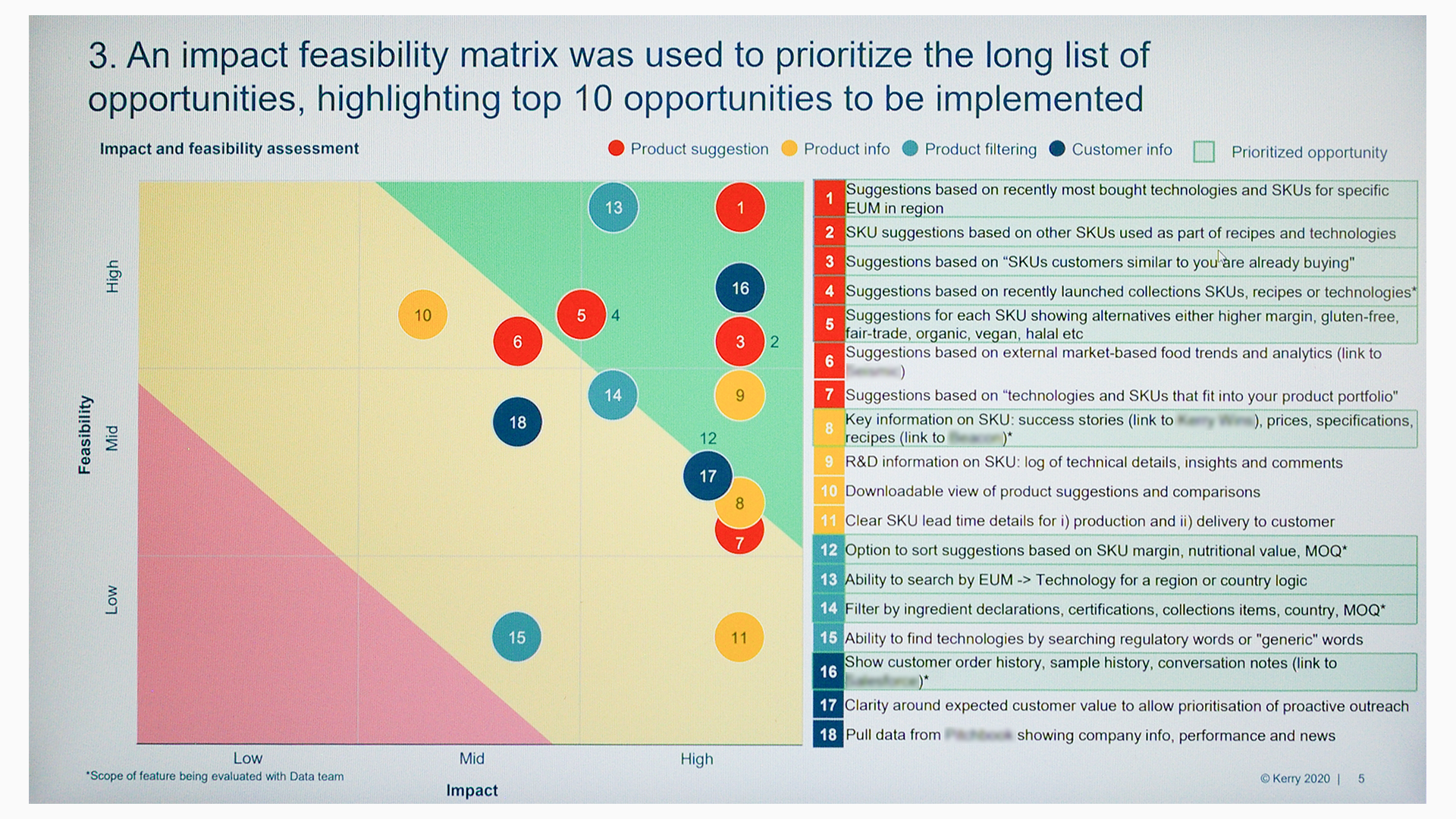
Using the How Might We design thinking method, key insights were derived from the ‘understand’ sprint, which led to a list of 50+ product features which were further refined into a shortlist of approximately 18 ‘North Star’ product features, with 10 prioritised for the MVP using an Impact/Feasibility matrix.
Some of the key insights included:
- Account managers are missing opportunities to cross-sell to customers due to a lack of time and technical support
- Existing tools do not exist to proactively spot new opportunities with customers
- Existing methods and tools for product search are not optimised for account managers
- Account managers have to rely on R&D experts for insights
- Customers expect guidance on making their supply chains more sustainable
How Might We, Impact/Feasibility matrix
Scenario development
Given the limited time allocated to the project, the initial product features were mapped to two primary scenarios for the MVP.
These consisted of:
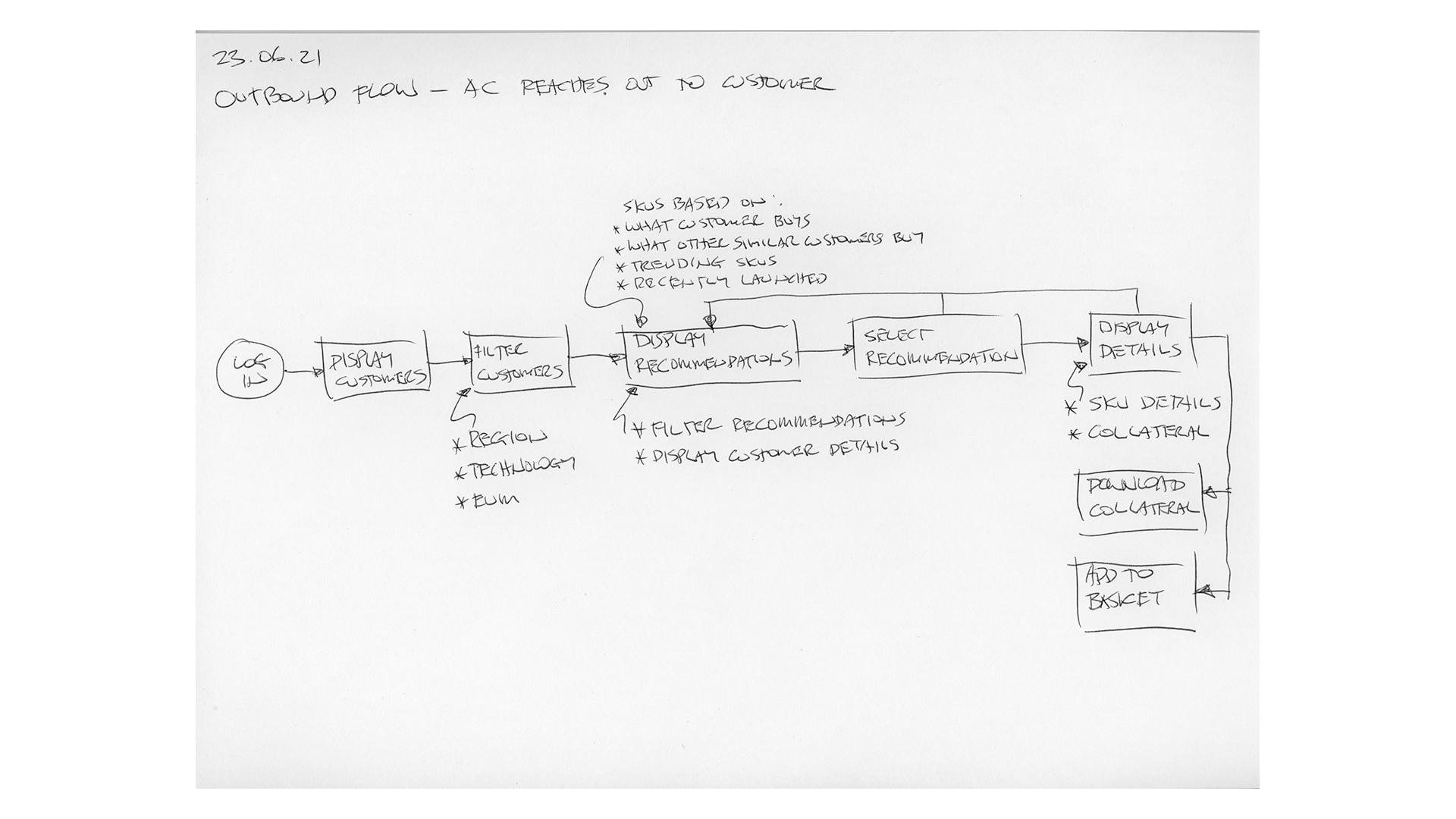
- A proactive scenario, where the account manager reaches out to a customer with product suggestions based off the recommendation engine
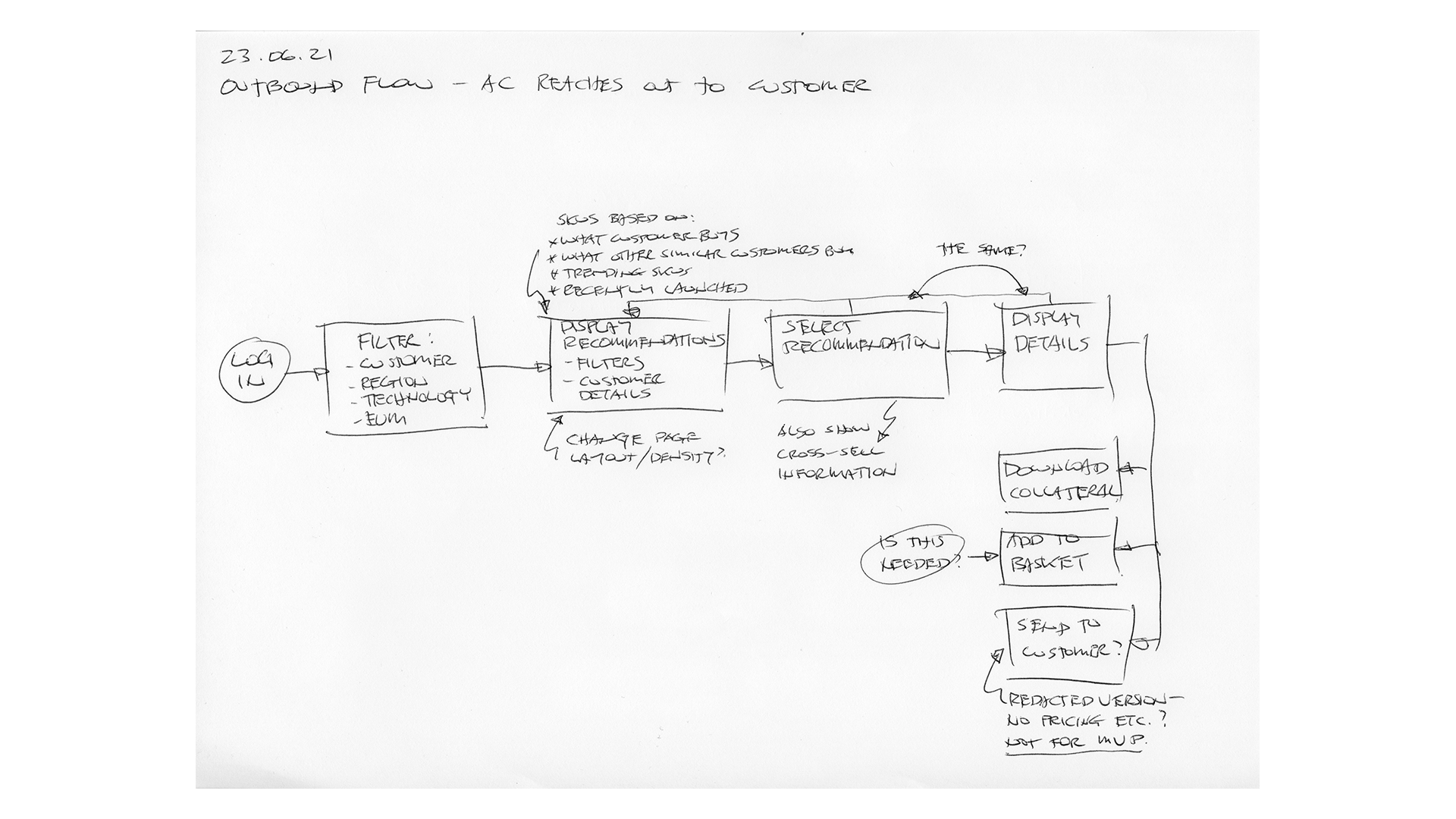
- A reactive scenario, were the customer connects with the account manager looking for product recommendations, and the account manager can also suggest additional products that complement the initial request
Solution development
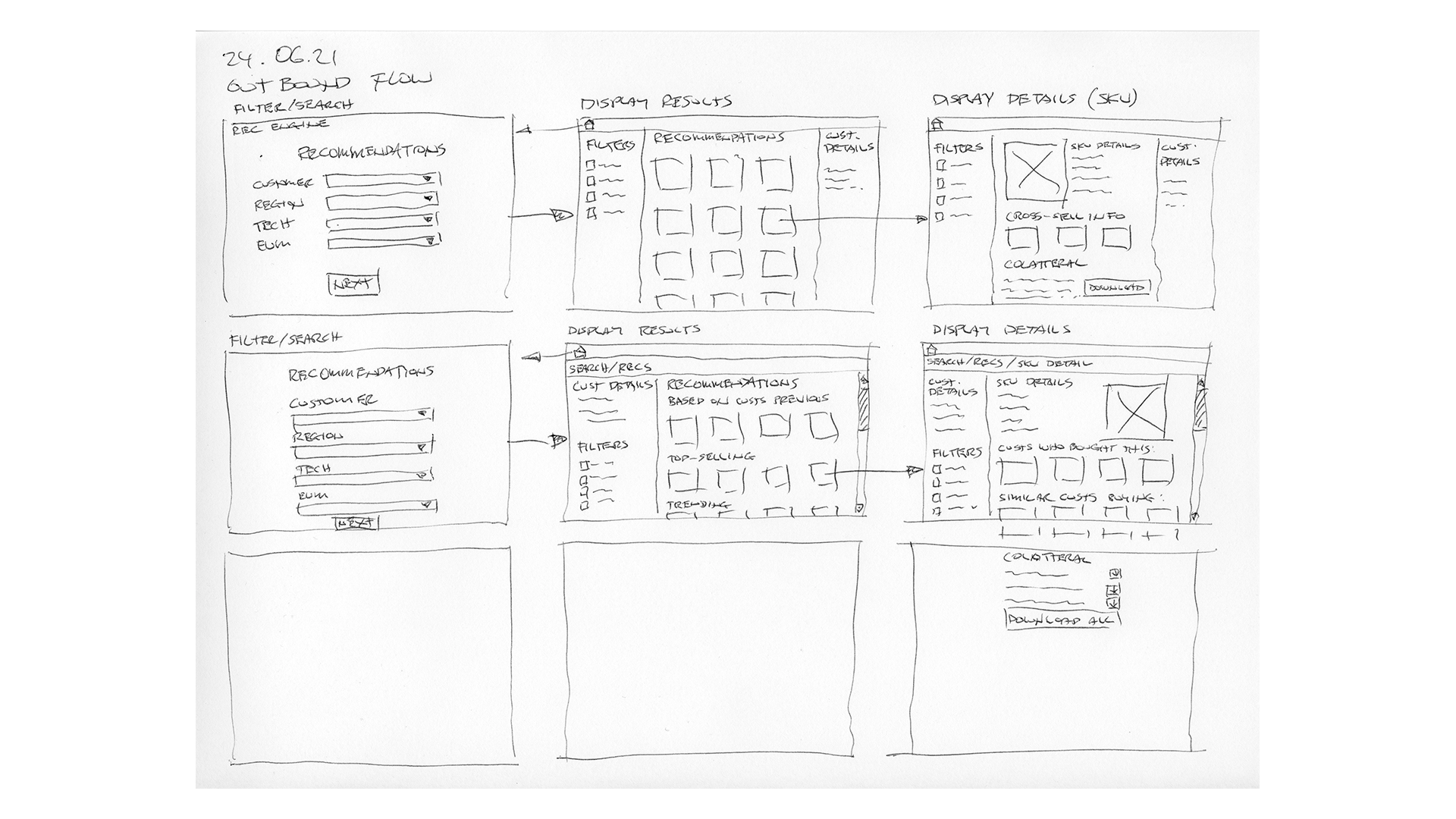
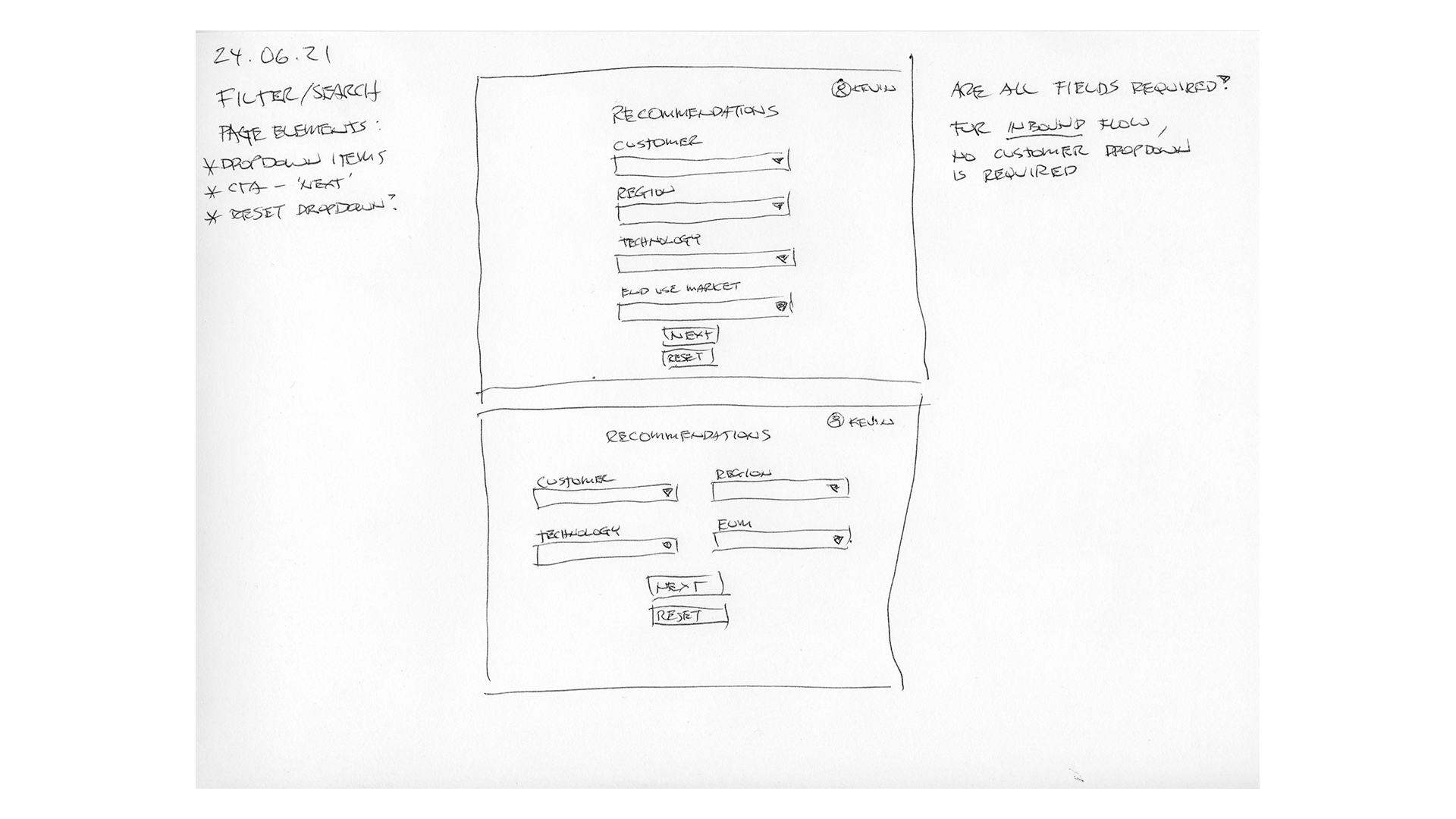
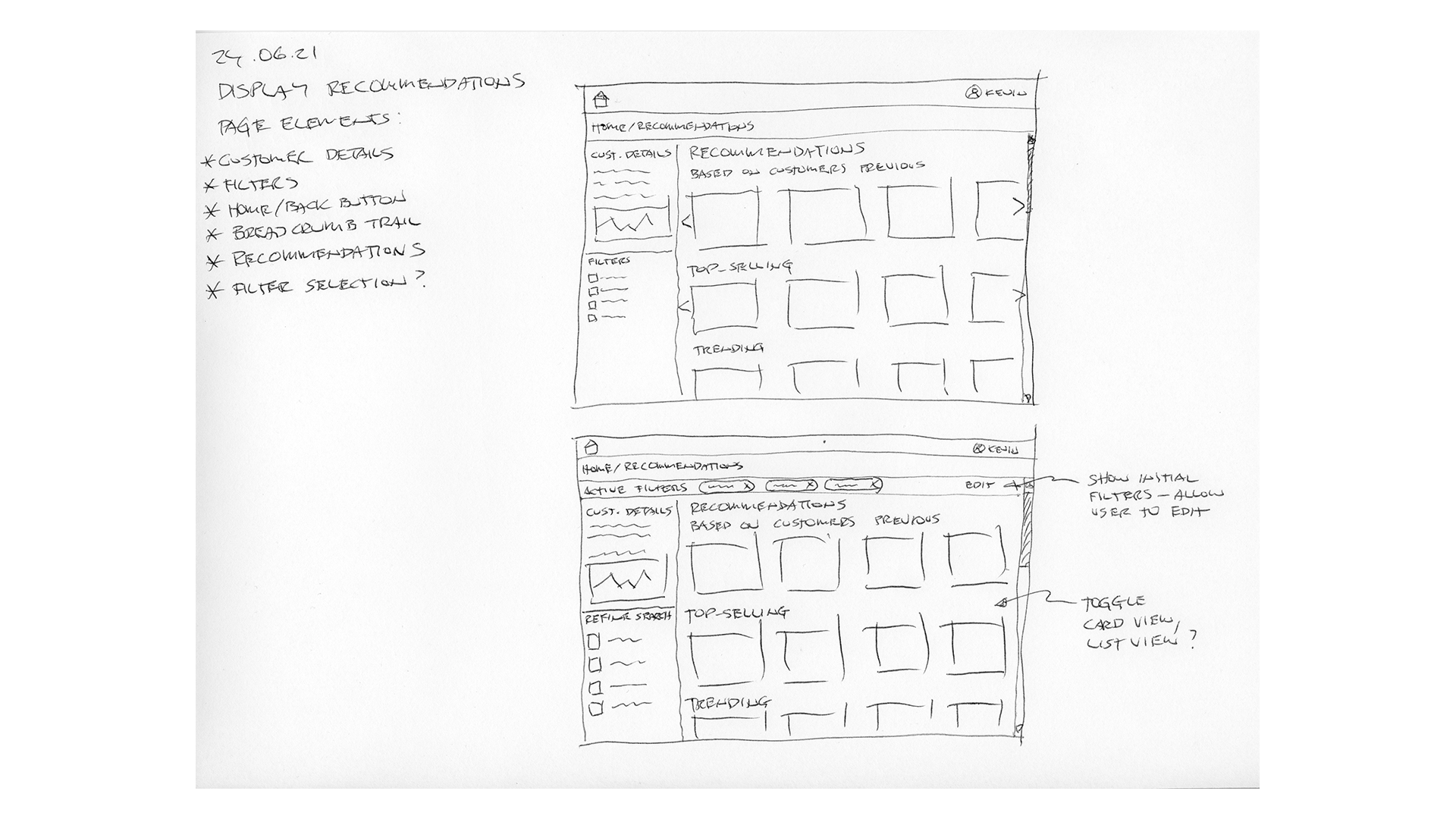
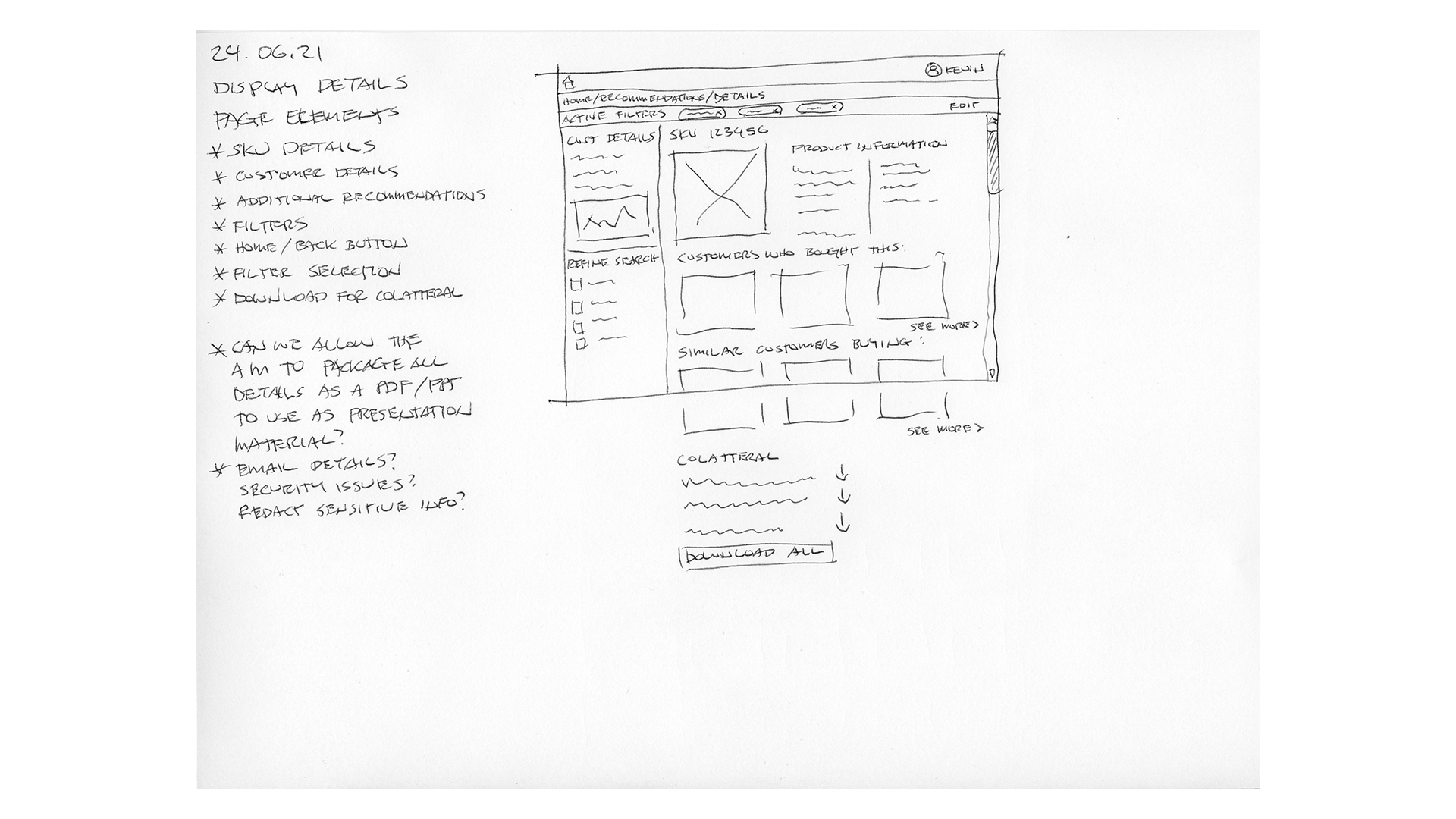
User flows were generated to reflect the two scenarios, and following whiteboarding sessions, initial wire-frames were generated for the scenarios.
The application contained:
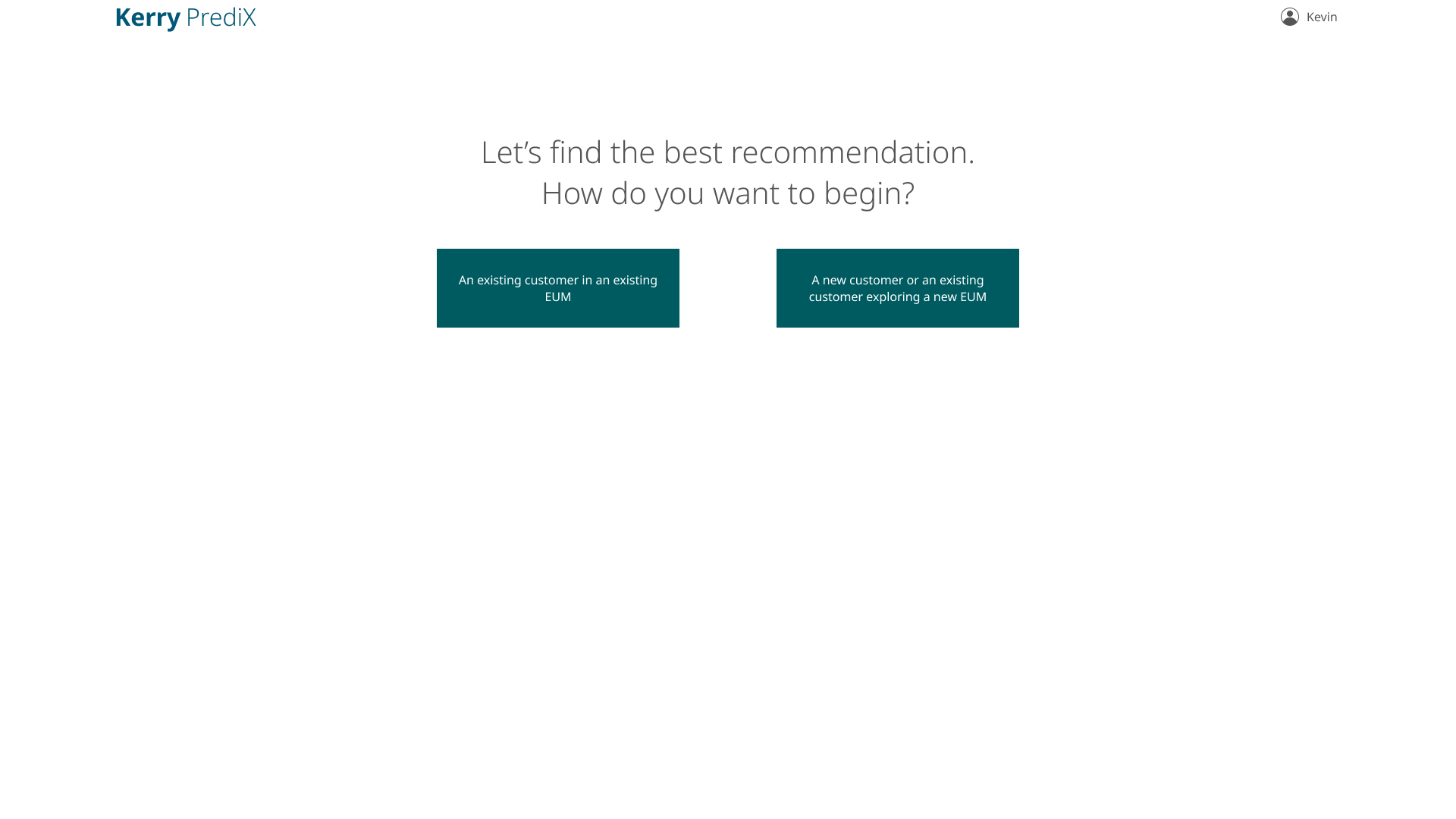
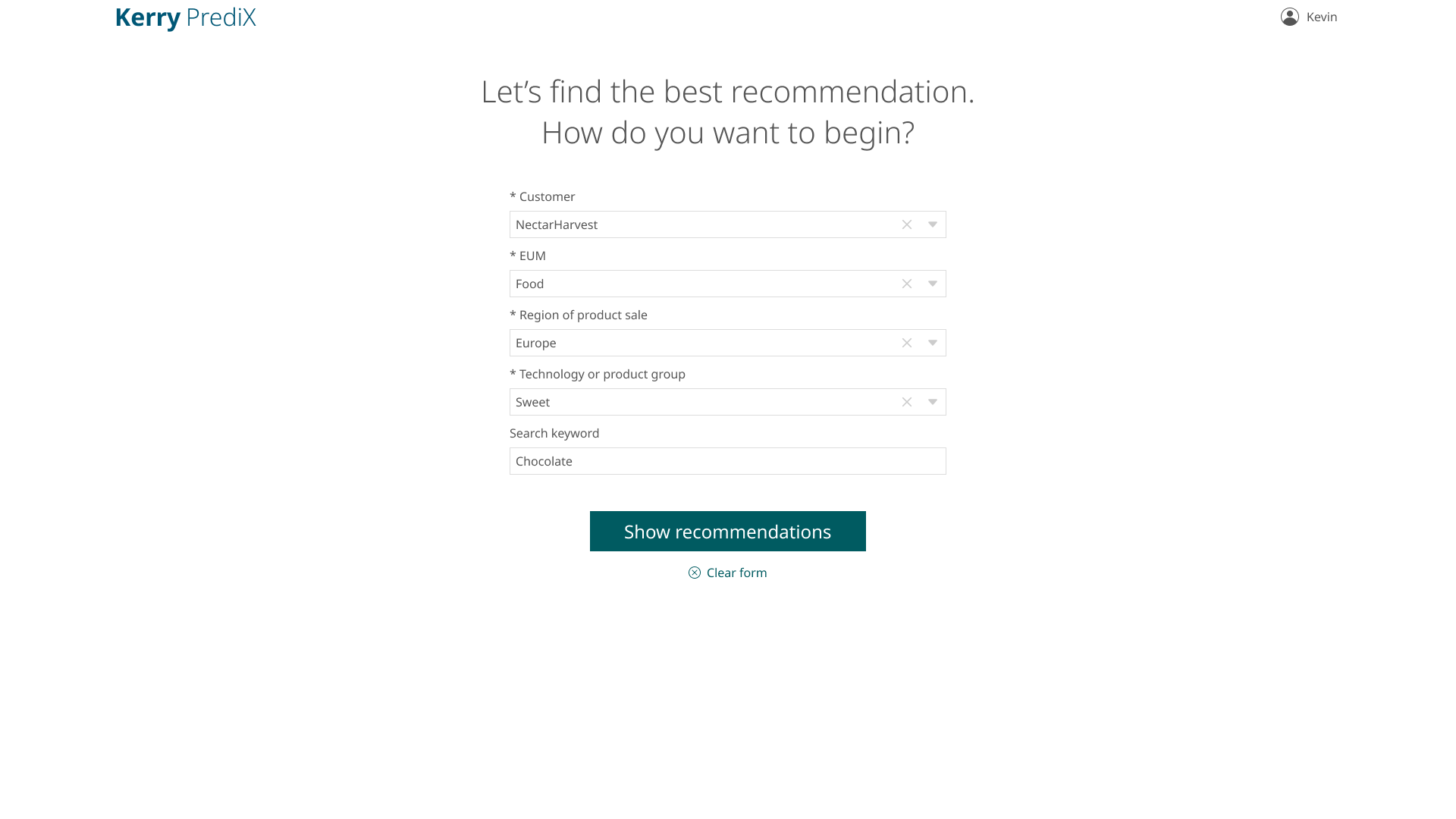
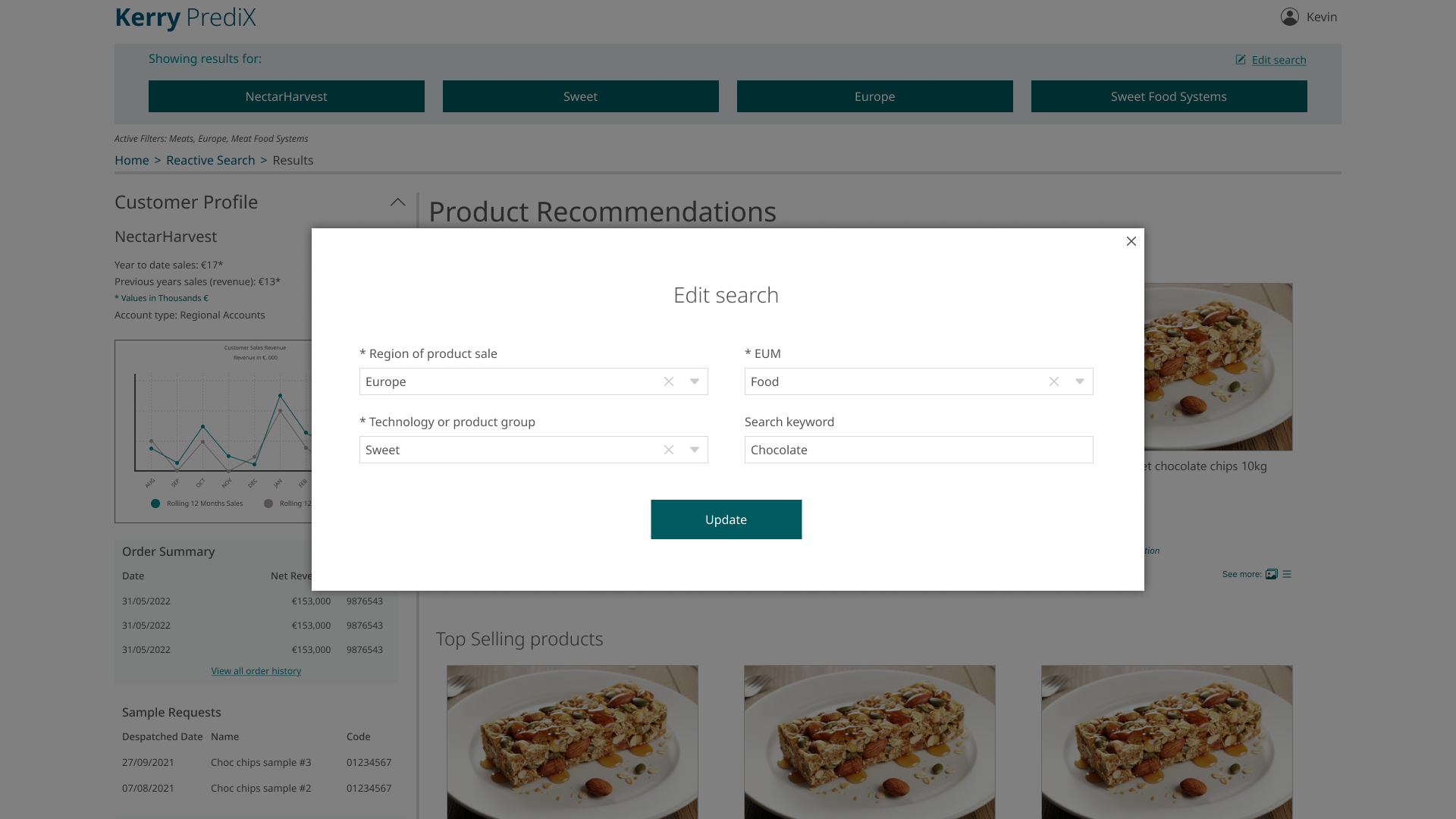
- A landing page to set the search criteria
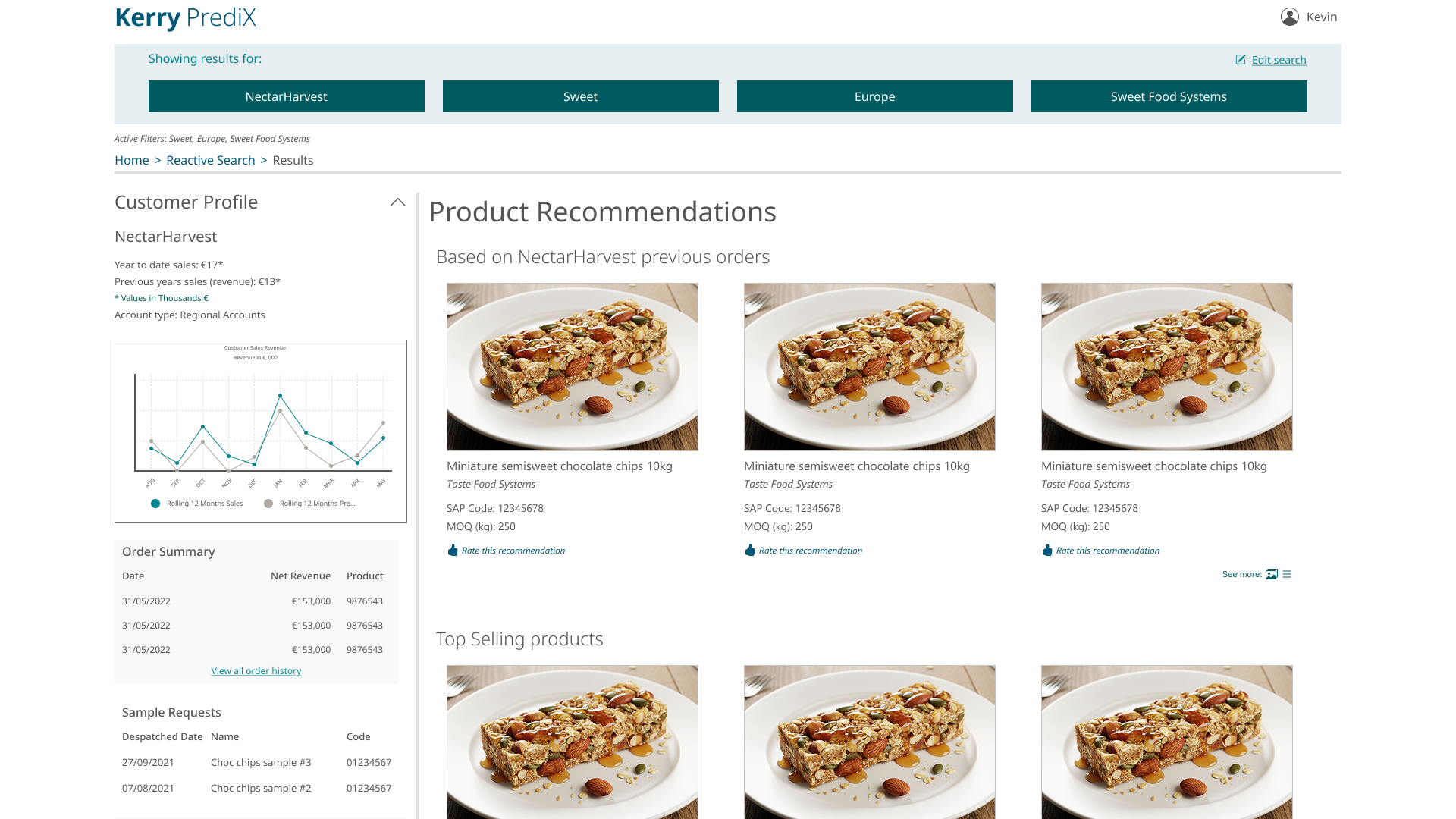
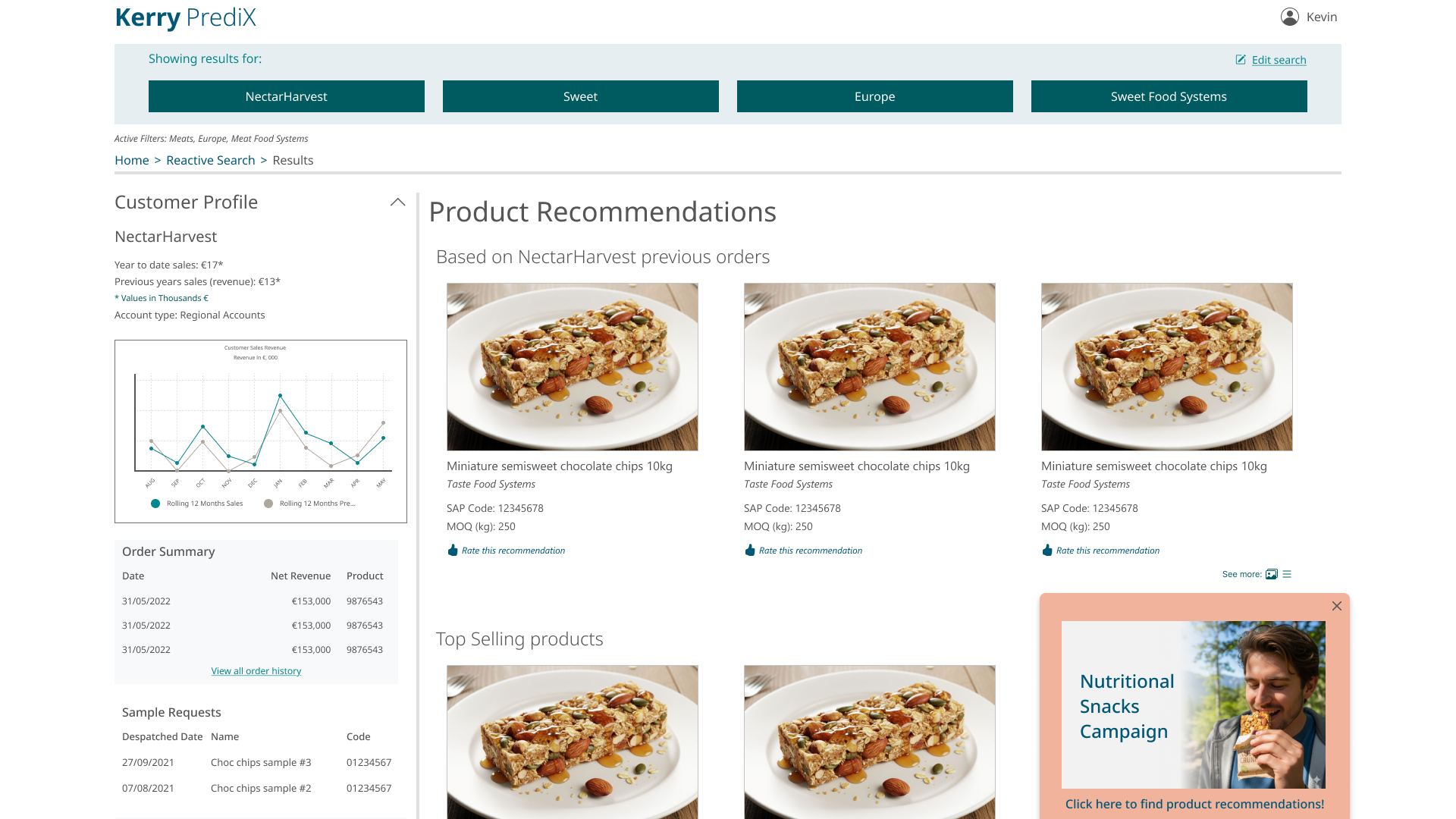
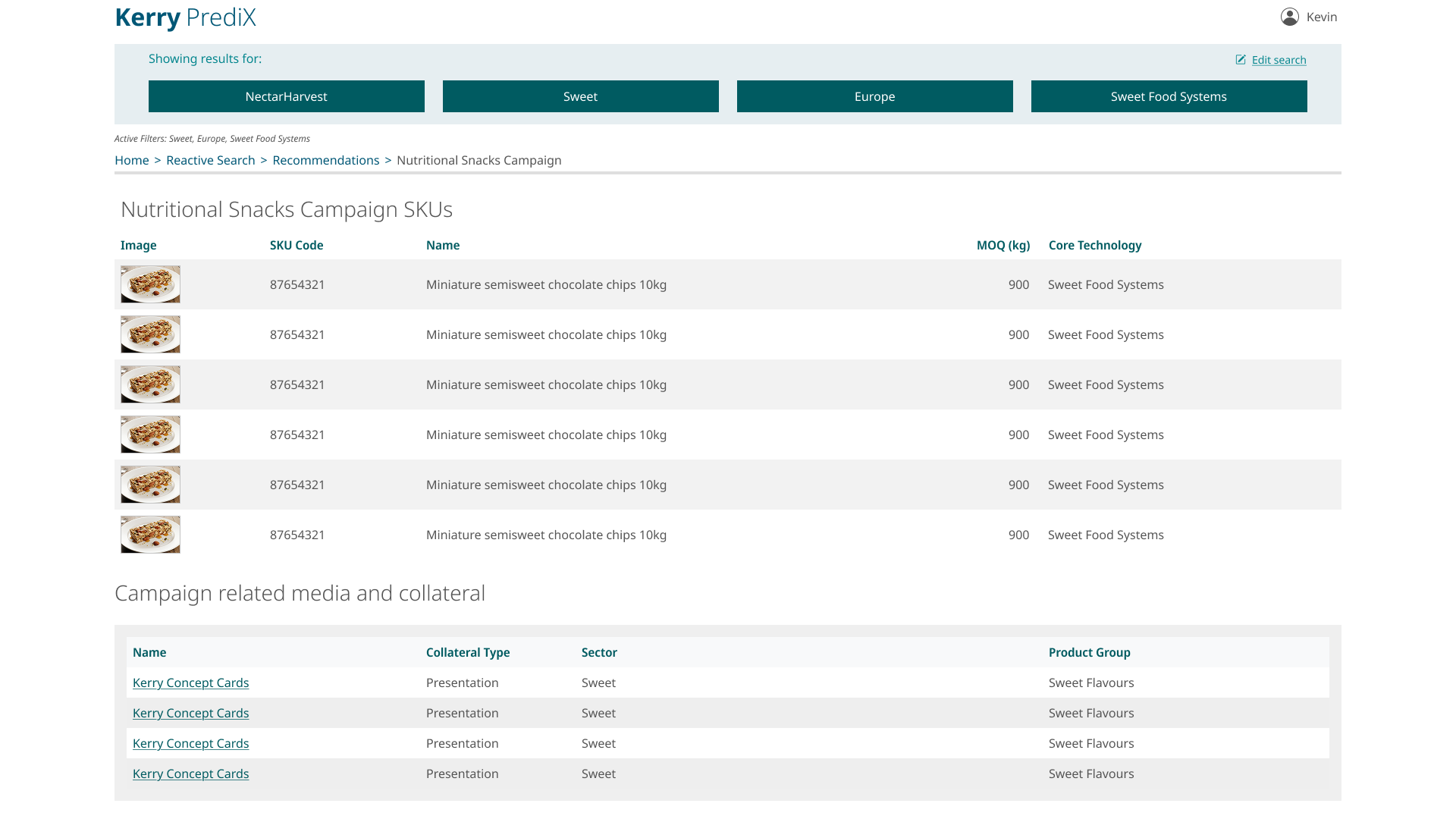
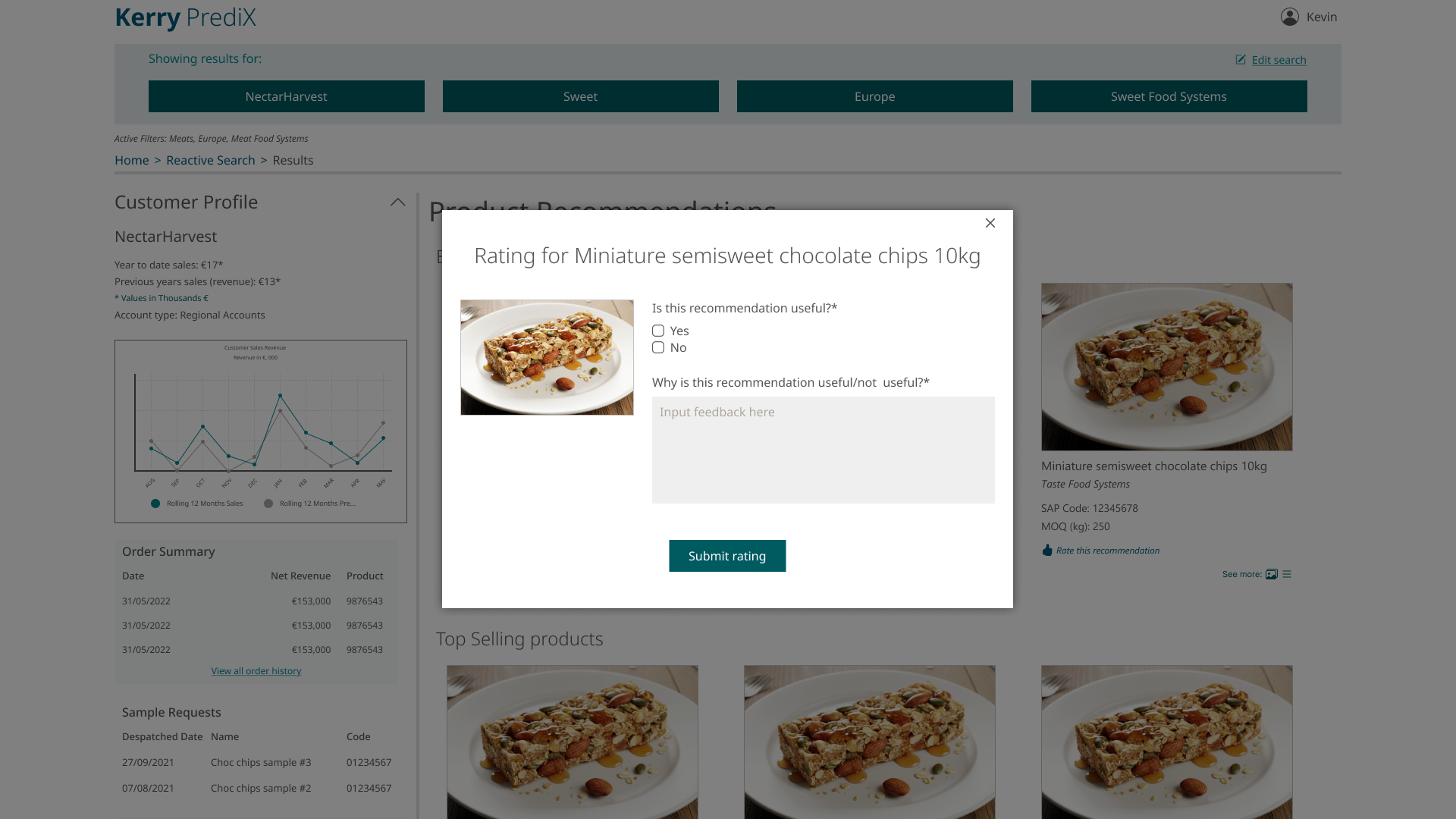
- A results page that displayed basic customer account information and three sets of recommendations based on what the customer might be interested in, top selling products, and products that were new to the Kerry offering
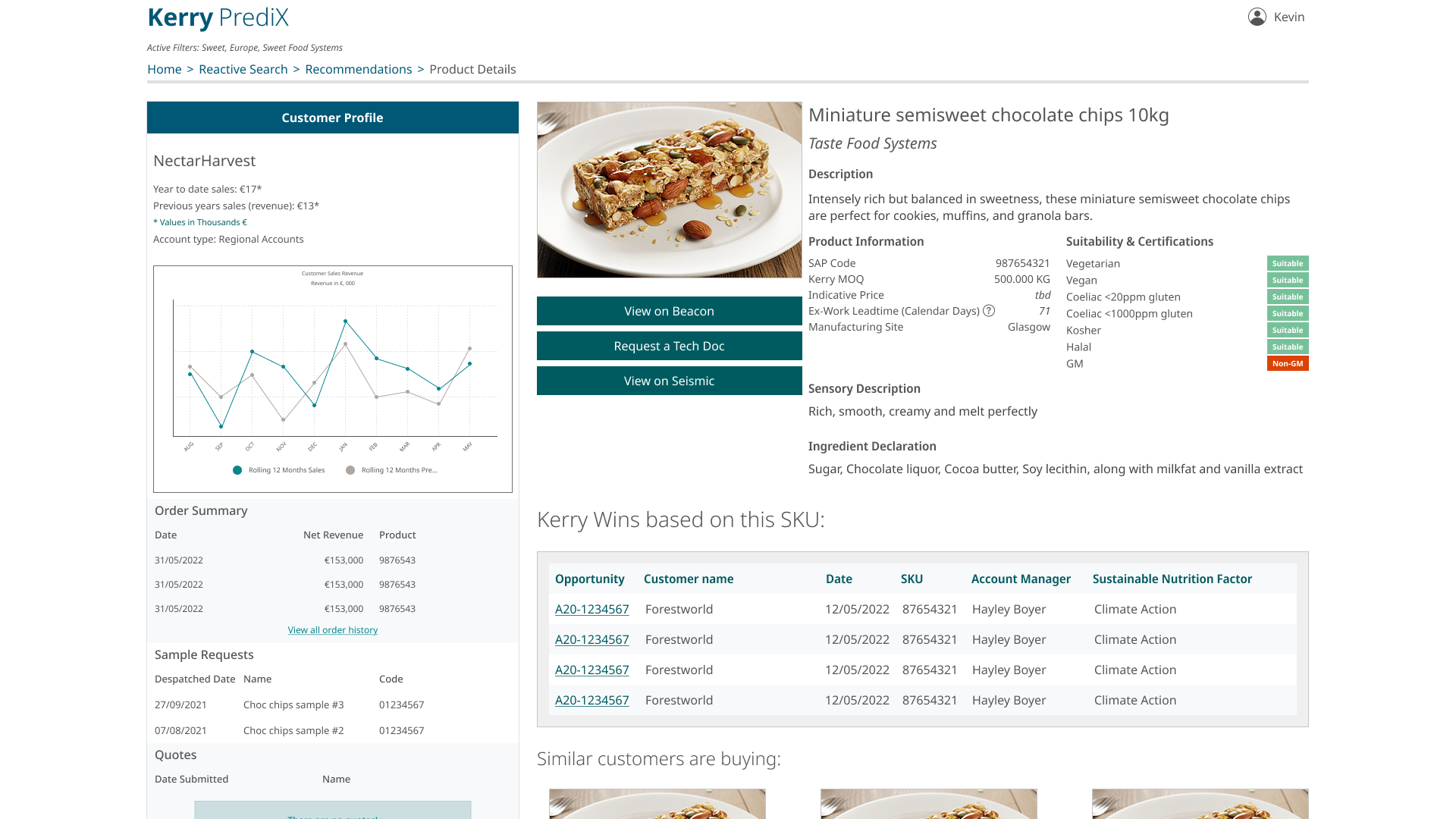
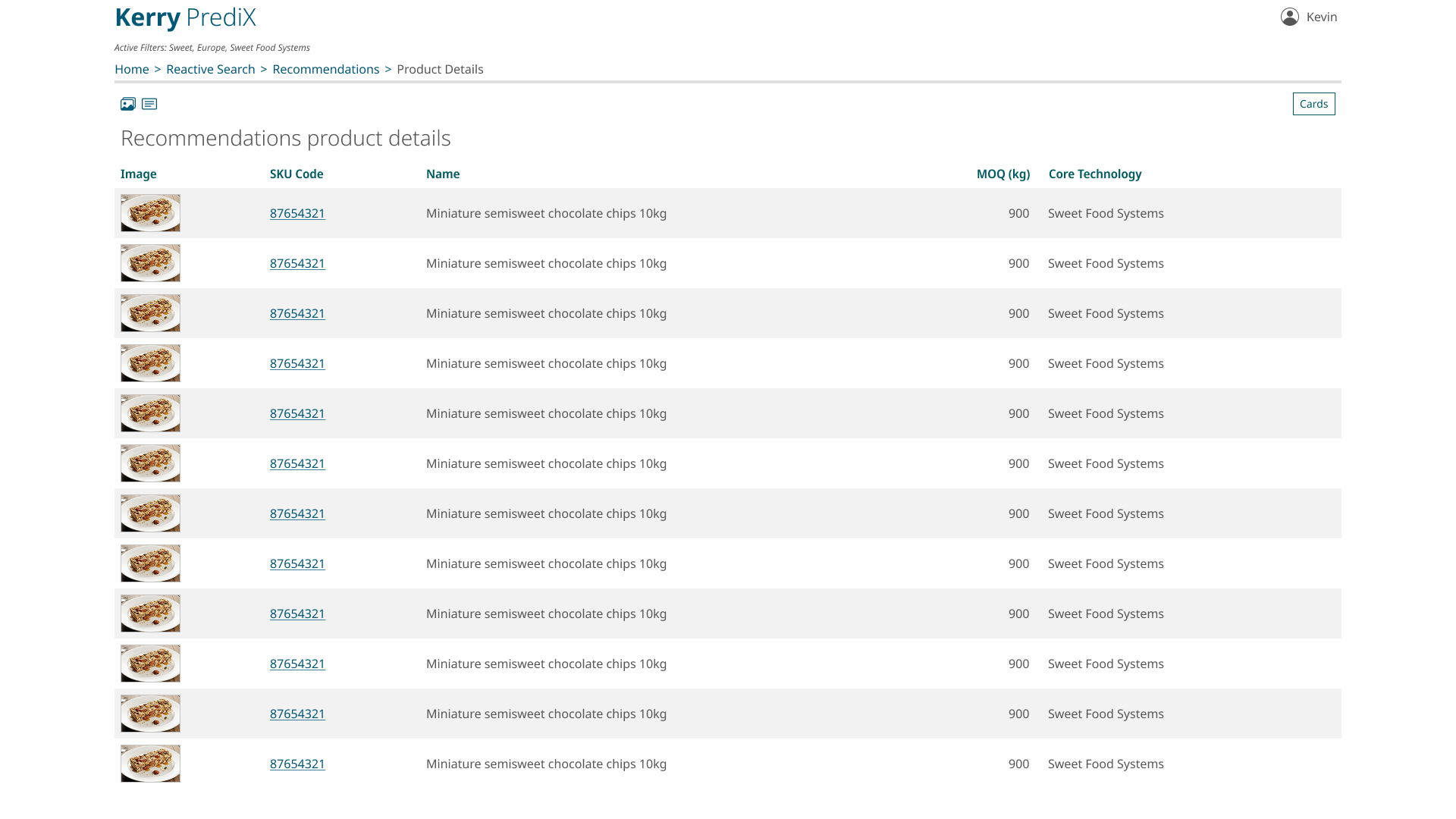
- A product details page (for any product selected from the three recommendation sets) containing SKU (Stock Keeping Unit) details, collateral associated with the SKU, and additional recommendations related to the SKU
Users could apply additional sorting and filtering to the suggested recommendations, or refine their search. The wire-frames were used to build high-fidelity layouts in Adobe XD, which were refined based on user testing of the XD wire-frames and with input from the Power BI developer. Basic brand guidelines were used when styling the application UI. Given the aggressive nature of the project timelines, it was decided to build the MVP on the Power BI platform.
User flows and wire-frames
Proof of Value
The ‘Proof of Value’ phase ran for eight weeks over four sprints.
Development began on the Power BI application, including building out supporting data pipelines and consolidation of data into a data lake. Investigation began into the visualisation methods available in Power BI to support the wire-frame design (input methods, tables, graphs).
Testing and iteration
A set of initial users were on-boarded to test the MVP. Testing was carried out remotely using screen sharing, and was both task-based and exploratory. Test results were collated and clustered to uncover common usability issues.
Testing resulted in updates to the UI and refinements to the data pipeline and the recommendations engine.
At the end of the Proof of Value phase, the MVP was officially launched.
Post-MVP development and Impact
Following the MVP launch, subsequent sprints focused on refining the user experience and integrating key features identified during the initial discovery phase. To facilitate the short developmental timelines, the original MVP was built on the Power BI platform and was subsequentially successfully migrated to a web-based platform, significantly improving performance and enabling the team to scale the solution for broader use.
At the time, our brand guidelines did not cover in-house web applications. As a result, the design team extrapolated branding and colour palettes from existing print materials to ensure visual consistency.
The user base was expanded to include participants from additional geographic regions, enhancing the diversity of feedback. Regular check-ins with a core group of users were established to gather ongoing insights into usability and the relevance of recommendations generated by the application.
In alignment with the original project goals, the initiative served as a blueprint for faster delivery and innovative ways of working across Kerry. The final product empowered account managers with a powerful new tool to support customer engagement and extend the reach of Kerry’s product offerings.
Application screenshots
Please note that much of my work with Kerry Group is confidential and many visual examples have been redacted. Many thanks for Kerry Group for allowing me to use these examples.
